

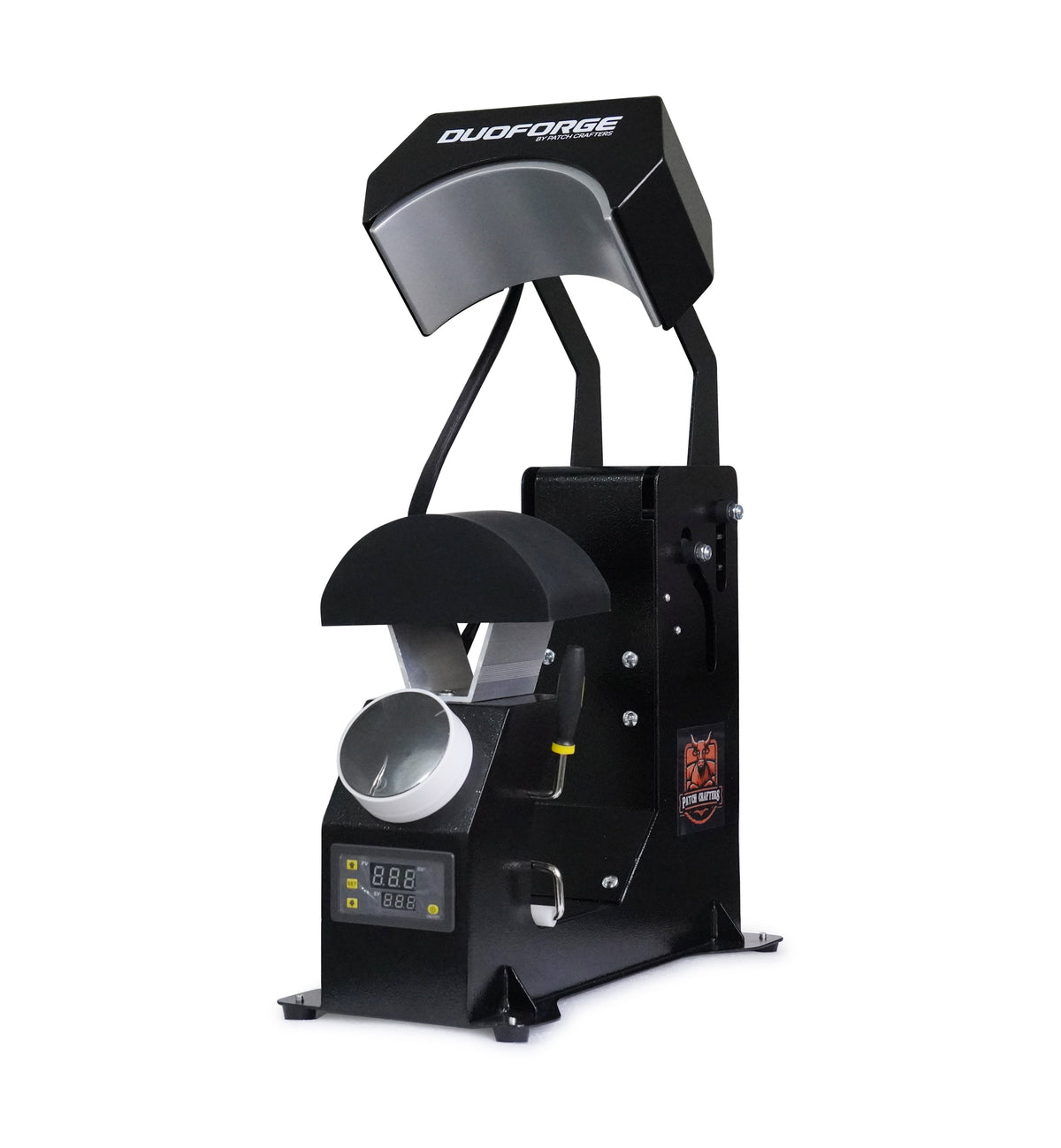
Quick answer: for thin transfers like heat-transfer vinyl, a single-heat cap press is enough. For thick patches (leather, leatherette, PVC and acrylic), heat from below makes a real difference. The adhesive sits on the back of the patch, against the cap, and a heated lower platen reaches it through the thin cap fabric while the top plate stays gentler on the patch face. You can buy a dual-heat press like DuoForge ($349) or add bottom heat to a compatible single-heat press with the Heat Dualizer ($128).
Why thick patches struggle on a single-heat press
A thick patch insulates. With heat only on top, the heat has to travel through the whole patch before the glue on its back melts. So you press hotter or longer, which can scorch, shine or warp the face, and the glue under the edges, where the cap curves away, may still not fully melt. That's the usual reason patch edges lift a few days later.

Single heat vs dual heat, side by side
| Single-heat cap press | Dual-heat cap press | |
|---|---|---|
| Heat | Top platen only | Top platen plus a heated lower platen with its own controller |
| Best for | Vinyl, DTF and other thin transfers | Leather, leatherette, PVC and acrylic patches, plus thin transfers |
| Thick patches | Needs longer or hotter top heat; more risk of a scorched face and soft edges | Glue heated from both sides; the top can run gentler |
| Leatherette example | 300°F: pre-heat the cap 30 s, press the patch 25 s | DuoForge: 300°F top, 320°F bottom, pre-heat 25 s, press 25 s |
Settings for every material and press are in the hat patch heat press chart.
Bottom heat isn't the only thing that matters
Four features decide how a cap press handles thick patches:
- Coverage. If the heated plate is narrower than the cap front, its edges press lines into the side panels and the patch edges get less heat.
- Curve. A plate curve that matches a structured trucker crown touches the whole patch; a generic curve touches the middle and leaves gaps at the sides.
- Pressure. Thick patches need firm, even pressure from edge to edge.
- The lower support. A flat, rigid form can fold the front of a structured cap and leave a crease; a rounded, cushioned base keeps it smooth.
DuoForge was built around those four points: a top platen with about 35% more heated area than similar presses, curves redesigned for structured trucker caps, a heated lower platen with its own controller, firm pressure for thick patches, a round silicone base that slides to fit, and automatic open and close.
Already own a single-heat press?
The Heat Dualizer is a 3" × 6", 250 W heat pad with its own digital controller. It replaces the unheated bottom plate of compatible single-heat automatic cap presses (check the compatibility list on the product page), so the patch gets heat from both sides. Our starting point for leatherette is 260°F top and 280°F bottom, with a 30-second pre-heat and a 30-second press at moderate pressure.
What it doesn't do: it doesn't change the size or curve of your top platen, and it won't fix creases caused by pressure, alignment or the shape of your press.
Which should you get?
- Mostly vinyl and thin transfers: a single-heat cap press is fine.
- Leather or leatherette patches, and you already own a compatible single-heat press: add the Heat Dualizer.
- Thick patches as a business, or edge lines and creases on your current press: a dual-heat press with full-front coverage and a matched curve, like DuoForge. Dedicated dual-heat cap presses with those features typically cost $770–$2,050 (2026 prices); DuoForge is $349.
FAQ
Can you press leather patches on a single-heat press?
Yes. On a top-heat-only cap press at 300°F, pre-heat the cap for 45 seconds, then press a full-grain leather patch for 45 seconds, adding 10–15 seconds if needed. Heat from below makes it faster and gentler on the patch face.
Why does the bottom platen run hotter than the top?
The cap fabric is thin, so heat from below reaches the glue quickly. Keeping the top cooler protects the face of the patch from scorching and shine.
Will a dual-heat press stop my patches from peeling?
It fixes the most common cause, glue that never fully melted under the edges. Pre-heating the cap and a plate that covers and fits the front matter too. See why hat patches peel off.